
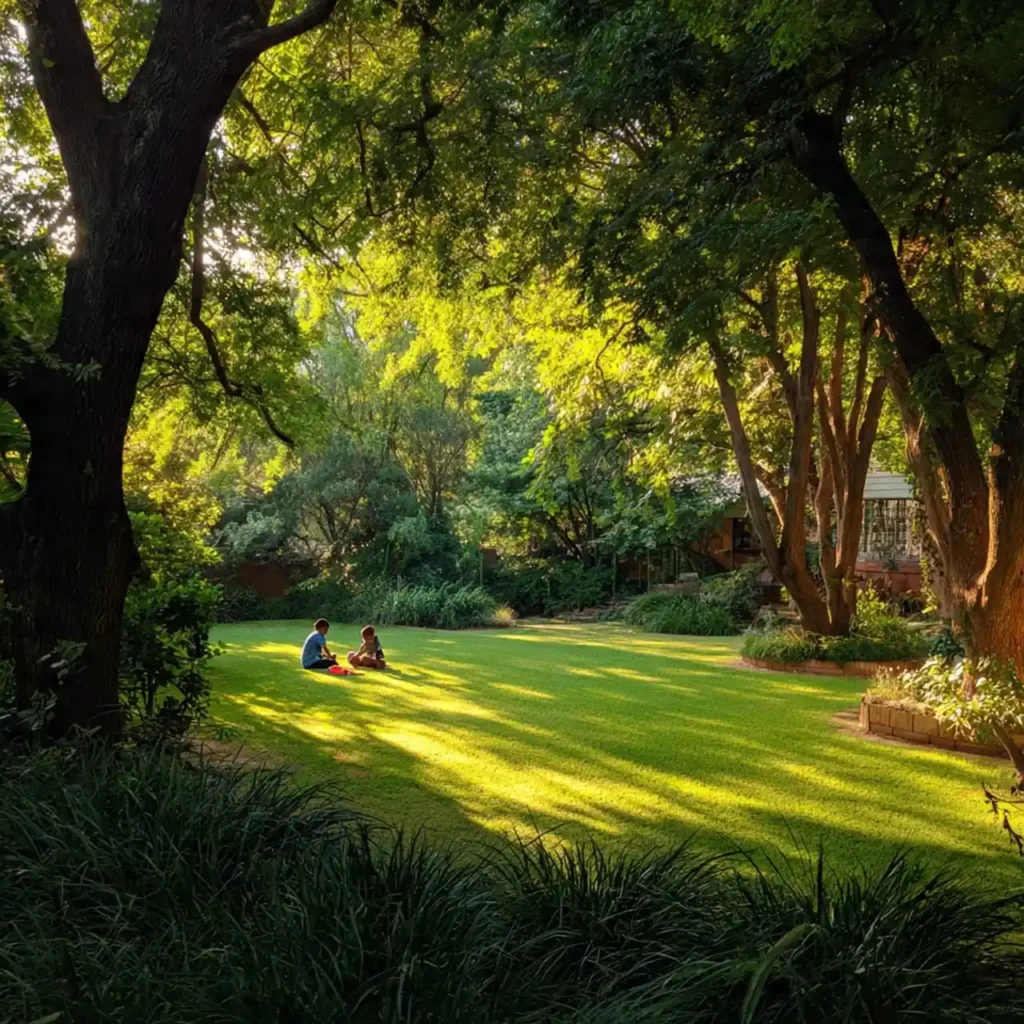
Why Midrand Homeowners Prefer LM Berea Grass for Shade
Shade changes everything about a lawn. A garden that looks lush in the morning sun can turn thin and patchy the moment a tree canopy blocks the light. Because of this, garden centres across Midrand consistently point homeowners toward LM Berea grass instead of Kikuyu grass whenever shade is the main challenge. This guide explains why that recommendation holds up, what actually happens to grass in low light, and how to choose the right instant lawn for your specific garden.
The Shade Problem in Midrand Gardens
Midrand’s leafy suburbs come with a trade-off. Mature trees, boundary walls, and double-storey homes all create pockets of shade that shift throughout the day. Grass, however, needs consistent light to photosynthesise and build the energy reserves that keep it dense and green. When light drops below what a species can handle, growth slows, roots weaken, and bare patches start to appear.
Trees also compete directly with turf for water and nutrients, which makes the problem worse in shaded beds. Research from Purdue University’s Cooperative Extension Service confirms that turf performs best with at least four to six hours of full sun a day, and that areas beneath dense canopies often struggle no matter which grass you plant. This is exactly why choosing the right variety from the start matters so much in a suburb like Midrand.
How Grass Responds to Low Light
Every grass species has a shade tolerance threshold. Push past that threshold, and the plant starts to show stress in predictable ways: leaves stretch and thin out, root systems shrink, and the overall stand becomes less dense. Mississippi State University Extension notes that no turfgrass species will grow in complete shade, which means the real question for any Midrand garden isn’t whether shade exists, but how much of it there is and which grass can still thrive under those conditions.
Why Kikuyu Grass Struggles Under Trees
Kikuyu grass earns its popularity for good reason. It’s hardy, it recovers quickly from wear, and it handles Midrand’s summer heat with ease. However, Kikuyu is a sun-loving species at its core. It needs strong, direct light to maintain its dense growth habit, and it simply doesn’t have the biological tools to compete for light the way shade-adapted grasses do.
Plant Kikuyu under a jacaranda, oak, or dense hedge, and you’ll likely see thinning within a season or two. The grass stretches toward available light, weakens, and opens the door to weeds and bare soil. For open, sunny gardens across Midrand, Kikuyu remains an excellent choice. For shaded corners, though, it sets homeowners up for ongoing frustration.
Why LM Berea Grass Handles Shade So Well
LM Berea grass evolved differently. Its shallow root system and broader leaf blades allow it to capture and use limited sunlight far more efficiently than sun-loving species like Kikuyu. This adaptation lets LM Berea maintain a dense, attractive lawn in conditions that would cause other varieties to fail.
Local turf suppliers commonly note that LM Berea tolerates up to 60% shade coverage, which makes it the standout option for Midrand properties with established trees or shaded courtyards. Its soft, apple-green blades also give gardens a refined, manicured look, so you don’t lose visual appeal while solving a practical problem. Because of this balance between performance and appearance, LM Berea has become the go-to instant lawn for shaded gardens throughout the area.
LM Berea vs Kikuyu: Where Each One Fits
The choice between these two grasses really comes down to matching the plant to the light conditions on site. Kikuyu thrives in full sun, tolerates heavy foot traffic, and suits sports areas, large open lawns, and family gardens where kids and pets need durable ground cover. LM Berea, on the other hand, prefers semi-shade to full shade, feels softer underfoot, but doesn’t hold up as well under constant traffic or rough play.
Many Midrand properties actually need both. A front garden that gets full sun all day might do best with Kikuyu, while a shaded side garden under a canopy calls for LM Berea. Understanding this split, rather than forcing one grass type across an entire property, is exactly the kind of assessment a proper site visit reveals.
Preparing Your Garden for LM Berea Installation
Getting LM Berea to establish well starts with the soil. Because this grass has a shallow root system, it depends heavily on nutrient-rich, well-draining ground rather than deep root penetration. This is where quality organic soils make a measurable difference, since compacted or nutrient-poor soil limits how well the roots can spread and anchor.
Before laying any instant lawn, it helps to clear the area of debris, break up compacted soil, and level the surface so the new turf sits flush and drains properly. Watering consistently during the first few weeks after installation also supports faster establishment, since newly laid turf hasn’t yet built the root network it needs to survive on its own.
When a Mixed Approach Makes Sense
Not every shaded garden is uniformly dark. Dappled light beneath a jacaranda, for instance, changes throughout the day and across seasons. In these in-between zones, a site assessment often reveals that a hybrid approach, such as pairing LM Berea in the darkest corners with a hardier variety elsewhere, delivers the best long-term result. This is precisely why garden centres and turf specialists recommend a proper consultation rather than a one-size-fits-all lawn choice.
Get the Right Grass for Your Midrand Garden
Choosing between LM Berea and Kikuyu grass isn’t a guessing game. It comes down to how much sun your garden actually receives, how the space gets used, and what look you want to achieve. Our team at Turf Company has installed both varieties across Midrand suburbs, including shaded properties in areas like Saddlebrook, and we assess each site before recommending a grass type.
If your garden has shaded patches that just won’t stay green, get in touch with our team for a site consultation. We’ll walk you through which grass suits your specific light conditions, prepare the soil correctly, and install a lawn built to thrive in the space you actually have.