
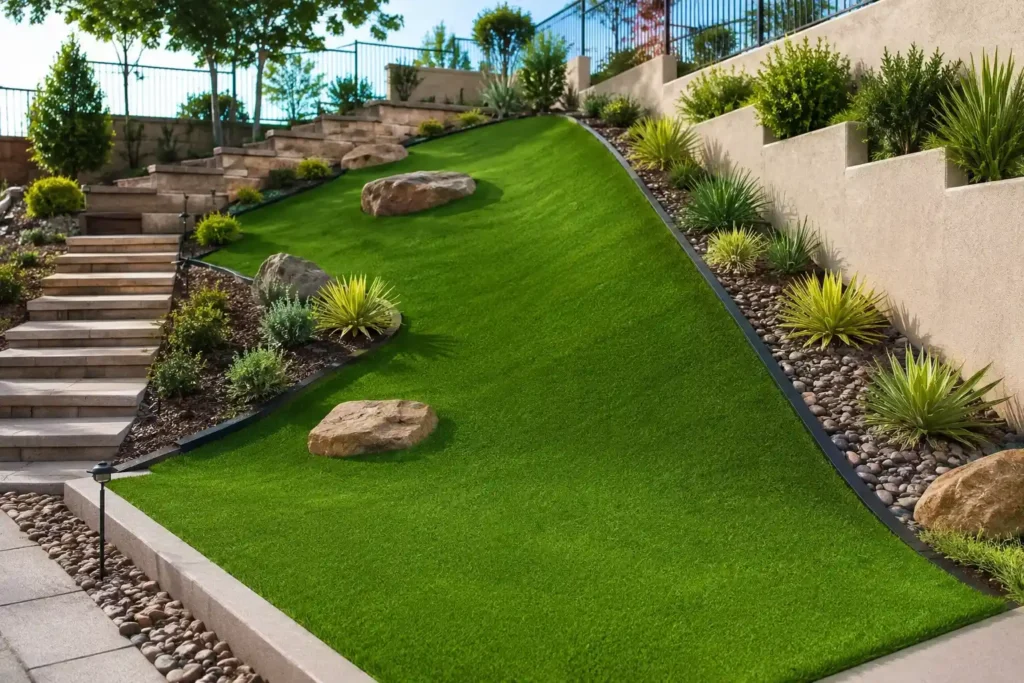
Installing Artificial Grass on Sloping Gardens in Midrand
Sloped gardens are common across Midrand. You’ll spot them often in Kyalami and Crowthorne, where many stands sit on graded ground. A slope can feel like a limitation. However, it doesn’t rule out a green, low-maintenance lawn. With the right base, artificial grass can go onto a slope. In fact, it often outperforms natural grass on an incline.
This guide covers how drainage, erosion control, and edge retention work together on a sloped site. It also explains the steps our team follows to keep artificial grass level, secure, and long-lasting on Midrand’s hillier stands.
Why Sloping Gardens Need a Different Approach
A flat lawn and a sloped lawn behave very differently once rain falls. On level ground, water soaks in gradually. On a slope, water speeds up as it runs downhill. It carries loose soil along with it. As a result, untreated slopes in Midrand often develop bare patches, small gullies, and muddy runoff onto paths and driveways.
Natural lawns struggle with this pattern. Grass roots need steady moisture to establish. On an incline, water reaches the bottom of the slope before topsoil can absorb it. Artificial grass sidesteps this problem entirely. It doesn’t rely on root growth or soil moisture to stay green. Instead, everything comes down to how well the team builds the base underneath.
The Role of the Sub-Base
Every successful slope installation starts below the surface, not on top of it. Our team excavates the area to a consistent depth. Then, we compact a layered stone sub-base that follows the garden’s contour. This layer does two jobs at once. It creates a stable, even surface for the turf, and it lets water pass through instead of pooling.
We angle the sub-base to match the land’s natural fall. This way, water moves through it in a controlled path rather than washing across the surface. That’s the main reason properly installed artificial grass often handles rain better than a natural lawn on the same slope.
Drainage: The Deciding Factor for Sloped Lawns
Good drainage separates a lawn that lasts for years from one that erodes within a single rainy season. On a slope, water always finds the fastest route downhill. So, the base has to guide that water rather than fight it.
Our installations use a permeable, free-draining aggregate base instead of solid concrete or clay. Because water filters straight through this layer, it doesn’t build up pressure or wash the base out from under the turf. In steeper Midrand gardens, we also add cross-fall channels within the base itself. These channels redirect surface water toward a drainage point, a stormwater outlet, or a planted bed at the bottom of the slope. Runoff therefore never collects against a fence line, wall, or neighbouring property.
Before excavation starts, our team also checks the existing organic soils on-site. Clay-heavy soil drains far slower than sandy soil. So a garden with high clay content usually needs a deeper stone base, plus extra sub-surface drainage points, to perform well long-term.
Preventing Soil Erosion Under and Around the Turf
Erosion doesn’t stop once the artificial grass goes down. It can still happen at the lawn’s exposed edges if the team doesn’t finish them properly. That’s why edge retention matters just as much as the base itself.
Retaining Edges and Borders
On a slope, the lawn’s perimeter takes on far more pressure than it would on flat ground. Without a solid boundary, soil at the edges can wash out from under the turf during heavy rain. Over time, this causes the turf to sag or shift out of place.
To prevent this, we install rigid edging around the full perimeter, using treated timber, brick, or concrete borders. This edging locks the sub-base in place and stops water from undercutting the turf at the sides. On steeper stands, we sometimes add small retaining walls or terracing too. Terracing breaks a long slope into shorter, more manageable sections. It also makes the finished garden easier to walk on, since a series of gentle steps is safer than one continuous incline.
For more background on how retaining structures reduce soil movement on inclined land, see the RHS guide to steep banks and slopes. It focuses on planted gardens rather than turf, but the erosion principles still apply.
Securing the Turf Itself
Once the base and edging are in place, we pin the artificial grass down. Where needed, we glue the seams and perimeter too. On a slope, we add extra fixing pins along the lower edge, since gravity puts the most strain on that section over time. This extra fixing stops the turf from creeping downhill after repeated rain and foot traffic.
Installation Method for Sloped Gardens in Midrand
The process for a sloped garden follows the same broad stages as a flat one. However, each stage needs more precision. Site assessment comes first. Our team measures the gradient and checks for existing drainage points, walls, or structures nearby. From there, excavation removes old grass, weeds, and loose topsoil down to a stable base level.
Next, we lay the compacted stone sub-base, shaped to follow the slope while still letting water drain sideways and downward. Edging follows straight after, since the team must fix it before measuring and cutting the turf. Finally, we roll out the artificial grass, trim it to shape, seam it, and pin it down. We pay extra attention to the lower edge and any terraced sections.
This same base-first approach works whether the finished space is a family garden, a section of landscaping turf around a pool deck, or a play area for children. In every case, we address the slope at the base level. We don’t just patch over it at the surface.
Getting the Right Advice for Your Slope
Every sloped stand in Midrand drains differently. Soil type, gradient, and distance from stormwater lines all play a part. For that reason, we recommend a site visit before you commit to a layout or a grass type. Our team can assess the gradient, check the soil, and recommend whether your garden needs terracing, extra edging, or additional drainage channels.
Industry-wide installation standards back up this approach too. The Synthetic Turf Council’s technical guidelines support a base-first, drainage-focused method for turf on uneven or graded ground.
Does your garden slope, and are you unsure whether artificial grass will hold up? Get in touch with our team for a free site assessment. We’ll walk the slope with you, explain what the base will need, and build a plan around how your garden actually drains.