Why Schools in Midrand Are Choosing Artificial Grass for Safer Play Areas
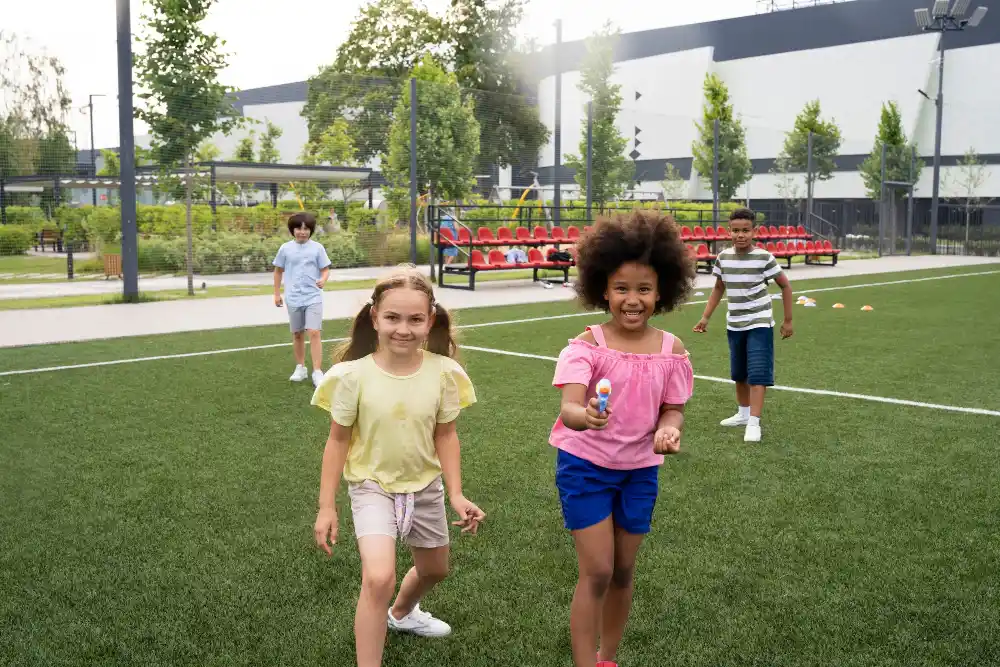
Every school and creche in Midrand faces the same problem. Natural grass wears out fast under hundreds of small feet, and bare, muddy patches become a daily hazard. As a result, more schools now turn to artificial grass for schools and playgrounds in Midrand as a safer, longer-lasting alternative. But the question every parent and principal asks first is simple: is it actually safe for children?
This post breaks down what the research says, what safety standards apply, and how a properly installed playground surface protects kids from day one.
Why Schools in Midrand Are Switching to Artificial Grass
Natural lawns struggle under constant foot traffic. Rain turns play areas to mud, while dry Highveld heat leaves bald patches that create trip hazards. Because school playgrounds see near-constant use, grass rarely gets the chance to recover between terms.
Artificial grass solves this problem differently. It stays flat, drains after rain, and holds up to daily play without losing its shape. Consequently, schools spend less on ground maintenance and more on the things that actually matter, like equipment and supervision.
Is Artificial Grass Safe for Children? What the Research Shows
Safety concerns around synthetic turf usually fall into three categories: chemical exposure, fall protection, and heat. Each one has been studied extensively, and each has a clear, practical answer.
Lead and Chemical Safety
In 2008, the U.S. Consumer Product Safety Commission tested synthetic turf fields across the country and concluded that young children were not at risk from lead exposure, since newer turf products contained little to no lead and even older fields released amounts too small to cause harm. Modern turf manufacturing has moved even further away from lead-based pigments since then. Even so, reputable suppliers only use non-toxic, child-safe materials as standard, not as an upgrade.
Shock Absorption and Fall Protection
Falls, not chemicals, cause most playground injuries. That’s why international playground safety standards focus heavily on impact absorption. The BSI Group explains that BS EN 1177 sets out a method for measuring how well a surface reduces head injury risk during falls from playground equipment, based on the broader safety principles for playground equipment set out in BS EN 1176. In other words, the surface underneath matters just as much as the equipment itself.
This is exactly why a shock-absorbent underlay, not the grass alone, does the real safety work. Turf without a proper base layer offers little more cushioning than a natural lawn.
Heat and Sun Exposure
Dark synthetic surfaces can get warm in direct sun, much like a dark-coloured driveway or roof. UV-stable fibres reduce this effect over time, and shaded play zones or scheduled watering further keep surface temperatures manageable during Midrand’s hottest months.
How Turf Company Midrand Builds Safe Playground Surfaces
Safety starts long before the grass gets rolled out. At Turf Company Midrand, every school and creche project follows the same structured process.
Site Assessment and Shock-Pad Design
First, the team assesses the play area’s size, drainage, and equipment layout. Because a swing set and a jungle gym have different fall heights, the shock-pad thickness gets calculated for each piece of equipment nearby, not applied as a blanket standard.
Non-Toxic, UV-Stable Materials
Next, ground preparation creates a stable, well-draining base. Then, non-toxic, UV-stable playground turf gets laid and secured firmly along every edge, so there’s no lifting or rippling underfoot. Finally, a safe infill helps the fibres stand upright and stay resilient under heavy daily use.
Artificial Grass vs Natural Grass for School Playgrounds
Natural grass needs mowing, feeding, and rest periods to recover from heavy use, none of which fit a busy school schedule. Artificial grass, by contrast, stays consistent year-round. It doesn’t turn to mud in the rain or bald out by mid-term, and it never needs a “keep off the grass” sign while it regrows. For schools managing hundreds of children daily, that consistency translates directly into fewer scraped knees and fewer maintenance headaches.
Where Else Schools Use Artificial Turf
Playground areas aren’t the only place synthetic grass earns its keep on school grounds. Sports fields benefit too. Multisport turf handles the wear of PE classes and after-school sport without the bald patches natural pitches develop over a season. Meanwhile, garden beds and quieter courtyard areas often still rely on organic soils to keep landscaping healthy alongside the turf.
Getting Started with a Safe Playground in Midrand
Artificial grass, installed correctly, gives schools a playground surface that’s non-toxic, shock-absorbent, and built to handle whatever a school day throws at it. The safety comes down to the installation, not just the material, so it pays to work with a team that designs the shock-pad and base layer around your specific equipment.
To find out more about Turf Company Midrand and how the team plans a playground installation for your school, get in touch for a free site assessment.